Veuillez utiliser votre appareil en mode portrait
Par William J. Ballow
À l'époque où Ballow vivait dans le comté de Smith, obtenir un brevet dans le Sud des États-Unis représentait un défi immense pour un inventeur noir. Malgré ce climat social difficile, il a réussi à protéger son idée, répondant à un besoin concret : l'optimisation de l'espace dans les habitations modestes. Son travail reflète une volonté de rendre le quotidien plus simple et plus économique pour les familles américaines.
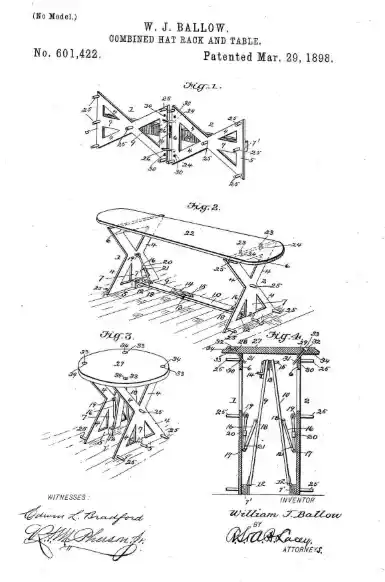
Le 29 mars 1898, Ballow a reçu le brevet américain n° 601 422 pour son porte-chapeau et table combinés. Cet objet se caractérisait par une polyvalence exceptionnelle pour l'époque. Selon les besoins de l'utilisateur, le meuble pouvait être transformé rapidement.
Il servait initialement de porte-chapeau, mais disposait d'une surface plane escamotable pouvant faire office de table à repasser ou de support stable pour des lampes et des bougies.
L'invention de William J. Ballow est considérée comme l'un des ancêtres directs des tables pliantes et des planches à repasser contemporaines. En créant un meuble "simple, bon marché et pratique", il a anticipé les besoins modernes de modularité. Son héritage perdure dans les répertoires historiques des inventeurs noirs, illustrant leur contribution essentielle à l'amélioration des objets de la vie courante.
Bien que les détails de sa naissance et de sa mort restent à ce jour l'objet de recherches généalogiques, les archives de l'USPTO confirment son statut de citoyen inventeur et son ingéniosité technique. Sa réussite en tant que titulaire de brevet dans le Tennessee de la fin du $XIX^{e}$ siècle fait de lui un modèle de persévérance et d'innovation domestique.