Please use your device in portrait mode
By Jan Ernst Matzeliger
The son of a Dutch engineer and a Black enslaved mother, Matzeliger developed an early gift for mechanics in his father's workshops. At 19, he left Suriname for the United States, first working as a sailor before settling in Lynn, Massachusetts. At the time, Lynn was the world's shoe capital, but final assembly ("lasting") remained a bottleneck as it could only be done manually by highly skilled workers.
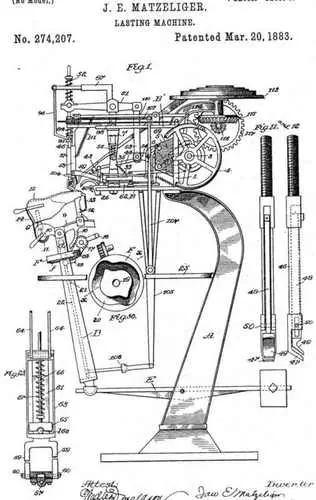
After five years of intensive research conducted in poverty, Matzeliger patented his lasting machine in 1883. His device replicated the complex movements of the human hand: it stretched the leather over the mold, folded it under the sole, and secured it with nails. While an expert worker could only assemble 50 pairs a day by hand, Matzeliger's machine allowed for the production of 150 to 700 pairs per day, doubling productivity while ensuring consistent quality.
Matzeliger's invention had a massive economic impact. By cutting the price of shoes in the United States in half, he made it possible for the working classes to afford decent footwear. His technology became the foundation of the United Shoe Machinery Corporation. Unfortunately, taken by tuberculosis at the age of 36, he never reaped the financial rewards of his genius, but his invention remains one of the most important in American industrial history.
Although he remained in the shadows for a long time, Matzeliger's crucial role has been rehabilitated by history. In a sign of national recognition, the United States Postal Service issued a commemorative stamp in his honor on September 15, 1991, celebrating his outstanding contribution to the country's technological and social progress.