Please use your device in portrait mode
By William J. Ballow
During the time Ballow lived in Smith County, obtaining a patent in the Southern United States was an immense challenge for a Black inventor. Despite this difficult social climate, he successfully protected his idea, addressing a concrete need: optimizing space in modest homes. His work reflects a desire to make daily life simpler and more economical for American families.
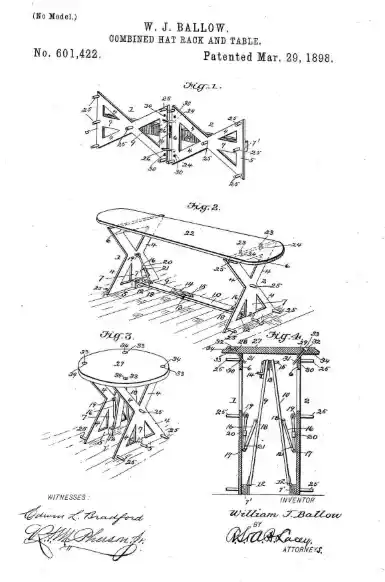
On March 29, 1898, Ballow received U.S. Patent No. 601,422 for his combined hat-rack and table. This item was characterized by exceptional versatility for its time. Depending on the user's needs, the furniture could be quickly transformed. It initially served as a hat-rack but featured a retractable flat surface that could function as an ironing board or a stable support for lamps and candles.
William J. Ballow's invention is considered one of the direct ancestors of contemporary folding tables and ironing boards. By creating a "simple, cheap, and practical" article, he anticipated modern needs for modularity. His legacy lives on in historical directories of Black inventors, illustrating their essential contribution to the improvement of everyday objects.
Although the details of his birth and death remain the subject of genealogical research, USPTO archives confirm his status as a citizen-inventor and his technical ingenuity. His success as a patent holder in late 19th-century Tennessee makes him a model of perseverance and domestic innovation.